Unpeened baseline
 Automotive
 Featured research · Automotive
MSc Automotive Engineering
Effect of Residual Stress on Fatigue Crack Growth on CT Samples (AA2024)
An experimental study of how laser shock peening changes residual stress, fatigue crack-growth behaviour and predicted life in aerospace-grade aluminium.
Research objective
Assess the influence of residual stress on fatigue crack-growth rate—and evaluate the life improvement produced by laser shock peening.
The work connects materials engineering, structural durability and data-led analysis: a strong Automotive project with a clear Technology dimension.
Experimental evidence
Inside the testing programme.
Original photographs reproduced from Sayaji Kakade's 2023 MSc dissertation report at Coventry University.
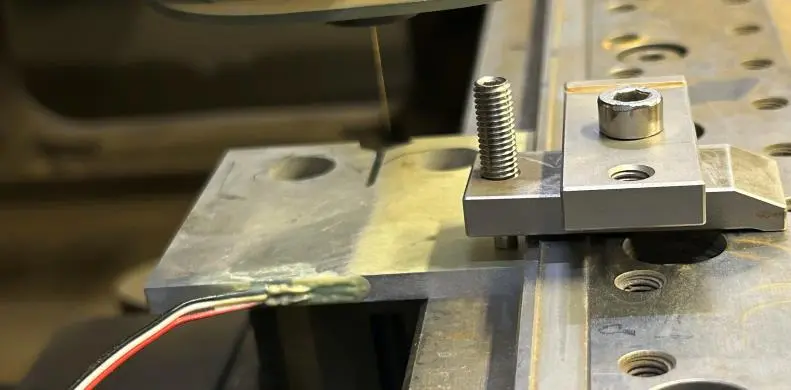
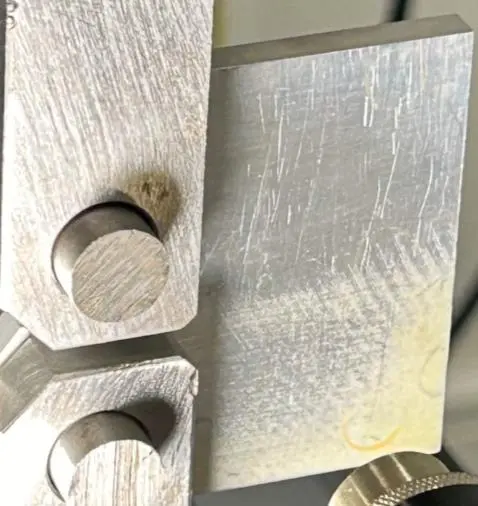
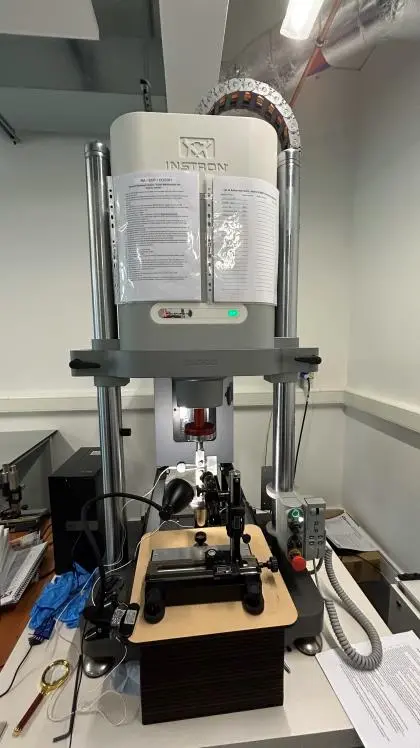
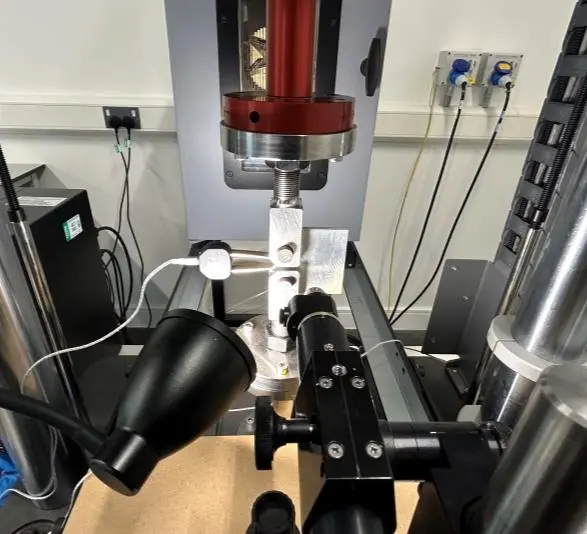
Experimental programme
Three conditions.
One controlled comparison.
Each compact-tension specimen was 5 mm thick. The peened specimens used a 15 × 15 mm treatment patch at two laser intensities.
LSP · 3 GW/cm²
Laser shock peened over a 15 × 15 mm patch to introduce a compressive residual-stress field.
LSP · 5 GW/cm²
The higher-intensity peened condition, assessed for the strongest fatigue-life improvement.
Methodology
From loading to
effective stress intensity.
Fatigue testing
Tests were conducted on a 3 kN Instron ElectroPuls at a load ratio of R = 0.1, following ASTM E647 practice and managed through Instron Console and WaveMatrix2.
Residual-stress measurement
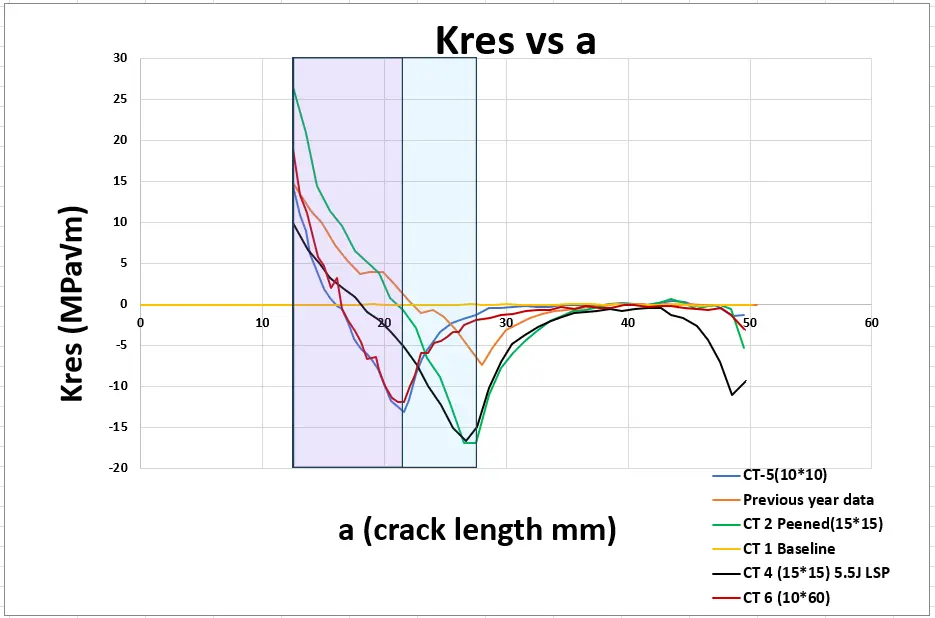
The slitting method combined a strain gauge with progressive EDM cutting to measure released strain and determine the residual-stress intensity contribution, Kres.
Crack-growth analysis
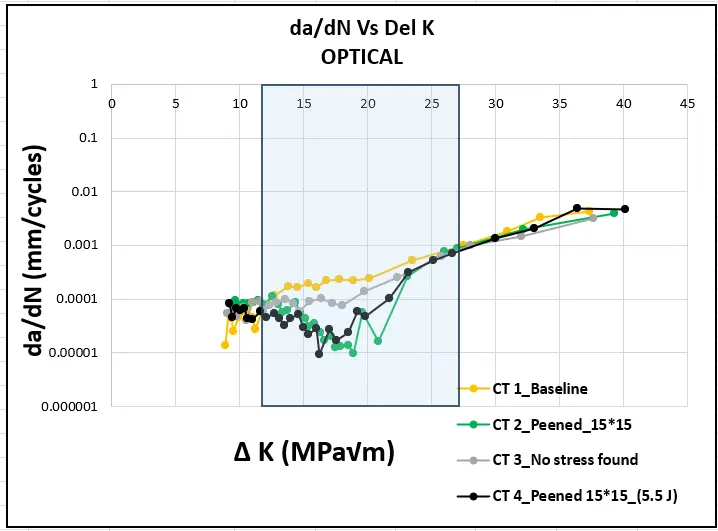
Paris’ Law described the propagation regime, while the Walker equation accounted for mean-stress effects and ΔKeff incorporated the measured residual-stress contribution.
Findings
Compressive residual stress improved the predicted fatigue life.
The unpeened CT1 result aligned with the established compact-tension baseline. Both laser-shock-peened conditions indicated life improvement, with the higher-intensity treatment producing the strongest response.
Research outputs
Evidence developed through the study.
- 01 da/dN versus ΔK comparison
- 02 Residual stress versus ΔK
- 03 Crack length versus load cycles
- 04 Comparison with previous CT and MT baselines
Connected capability
Automotive research, supported by technology-led testing and analysis.Explore Technology